

 English
 中文简体
 عربى

YITENG
YITENG
YITENG
YITENG
YITENG
YITENG
YITENG
YITENG
YITENG
Content
- 1 What Bearing Staking Means in Practice
- 2 Where Staking Shows Up in Bearing Assembly
- 3 Comparing Staking Methods
- 4 Common Staking Defects and Their Causes
- 5 Process Settings That Decide Success
- 6 Inspecting a Staked Joint
- 7 When a Molded Nylon Cage Removes the Staking Step
- 8 Retention in Needle Roller and Cage Assemblies
- 9 Staking in Automotive and Industrial Assemblies
- 10 Choosing the Right Approach With Your Cage Partner
If you have ever taken apart a small electric motor, a gear shift mechanism, or a conveyor idler, you have probably seen bearing staking without recognising it. A few small dents around a bore, a flattened rivet head, a deformed plastic boss — these are the visible traces of a joining process that holds a bearing, a cage, or a shield exactly where it needs to stay. It is fast, inexpensive, and almost invisible when it is done well. Done badly, it turns into a noise complaint, a torque problem, or a warranty claim.
This article walks through what bearing staking actually is, where it appears in bearing and cage assembly, which defects deserve attention, and when a molded cage can remove the staking step altogether.
What Bearing Staking Means in Practice
Staking is a deformation-based assembly method. A punch, pin, or shaped tool presses into a component and pushes a small amount of material sideways, so the displaced material overlaps a mating part and locks it in position. Nothing is welded, glued, or bolted — the joint depends entirely on controlled plastic flow of the base material. In different workshops you will hear the same operation called crimping, swaging, or upsetting; the principle does not change.
In bearing work, the word covers a family of closely related operations:
- Housing staking, where the housing material is pressed over the outer ring shoulder to stop the ring from turning or creeping.
- Cage closing, where rivets or integral lugs on a two-piece metal cage are staked over to hold the roller or ball set.
- Shield and seal staking, where a thin metal shield is locked to the outer ring.
- Heat staking and ultrasonic staking, where a molded plastic boss or pin is softened and formed into a head.
- Lug staking, where a small tab is deformed to prevent a component from rotating.
The reasons for choosing staking are practical. It is quick, it needs no extra components, it works on thin walls, and it suits automated presses with force monitoring. The trade-off is that the joint is permanent: a staked bearing is rarely meant to be serviced, and every staking stroke puts local stress into parts that were designed to run smoothly.
Where Staking Shows Up in Bearing Assembly
Housing and ring staking
Small motors, actuators, pump housings, and gear-shift units often hold an outer ring with three or four staked points. The housing material, usually aluminium or mild steel, is displaced over the ring shoulder, so no snap ring or heavy press fit is needed. Because the staking force travels into the bearing, the inner ring should be fully supported during the operation. Otherwise the rolling elements can leave brinelling marks on the raceways that only show up later as vibration.
Cage closing and rivet staking
Two-piece steel or brass cages are normally closed with rivets or integral lugs that are staked over. The head has to form evenly and symmetrically. An uneven head allows the two cage halves to shift against each other, which changes pocket clearance and can push starting torque upward.
Thermal and ultrasonic staking of plastic parts
Heat staking softens a molded boss or pin with a heated tool and forms a head over the mating part. Ultrasonic staking reaches the same result with high-frequency vibration in a short cycle. Both are common where nylon or glass-filled polyamide components must be captured without adding metal fasteners. Temperature and dwell time decide the outcome: too cold and the head cracks, too hot and the material sinks.
Comparing Staking Methods
The table below compares the methods we see most often in bearing and cage assembly, along with the risk that tends to matter most for each one.
| Method | How it works | Typical use | Main risk |
|---|---|---|---|
| Cold mechanical staking | Hardened punch displaces metal over a shoulder or into a groove | Outer ring retention in housings | Brinelling and ring distortion |
| Rivet staking | Rivet shank is upset to form a retaining head | Two-piece steel and brass cages | Uneven heads and loose cages |
| Heat staking | Heated tool forms a head on a plastic boss | Retaining molded cages and guides | Cracking, flash, and sinking |
| Ultrasonic staking | High-frequency vibration softens and forms the boss | Small plastic retainers and housings | Over-melting and short cycle drift |
| Snap-fit assembly | Molded hooks engage without a forming tool | One-piece nylon cages | Pocket clearance and creep over time |
Notice that four of the five methods deliberately deform a component. That is why the choice is rarely about which method is strongest, but about which one keeps the raceway geometry and pocket clearance closest to the drawing.
Common Staking Defects and Their Causes
Most staking problems trace back to a small number of causes, and they usually appear in this order of frequency:
- Loose joints after assembly, from under-staking, worn punch tips, or position-controlled presses without force monitoring.
- Cages running out of round, from an uneven stake pattern or insufficient backing support.
- Rising starting torque and audible noise, from cage distortion or changed pocket clearance.
- Cracks in plastic bosses, from a cold tool, undried material, or a cycle that is too fast.
- Brinelling on raceways, from staking force transmitted through the rolling elements.
- Burrs and loose particles, from tooling that is not cleaned or replaced on schedule.
Debris is the quiet one. A single staking burr left inside a bearing can do more damage after a few hundred hours of running than a slightly loose rivet ever will.
Process Settings That Decide Success
If you are setting up or troubleshooting a staking operation, these are the variables worth tightening first:
- Force and travel. Monitor force rather than relying on position alone, because material thickness and hardness vary from batch to batch.
- Tool geometry. Tip radius and angle control the shape of the formed head far more than pressure does.
- Support and alignment. Backing the ring and keeping the tool coaxial prevents force from reaching the raceways.
- Cycle speed. Slower forming reduces cracking in thermoplastics and gives metal time to flow instead of tearing.
- Cleanliness. Blow-off, tumble, or wash after staking, and inspect the tooling for pickup between shifts.
- Verification loop. Sample retention and torque checks on a fixed schedule, not only after a complaint.
Inspecting a Staked Joint
Inspection should be simple enough to run every shift. We look at stake head height and diameter against a boundary sample, push-off or retention load on a sample basis, starting torque after assembly, radial play and runout, and a quick acoustic check on a spinning fixture. Visual inspection under magnification catches most head defects before they reach a test stand. If a design allows it, keep a sectioned sample from the first-off part so operators can see what a correct joint looks like from the inside.
When a Molded Nylon Cage Removes the Staking Step
For many designs, the safest way to control staking risk is to delete the operation. A one-piece injection-molded cage with snap-fit retention holds the rolling elements without rivets, without heat, and without deformed metal sitting next to the raceway. The cage arrives ready to install, mass is lower, corrosion is a non-issue, and there is no rivet debris to control.
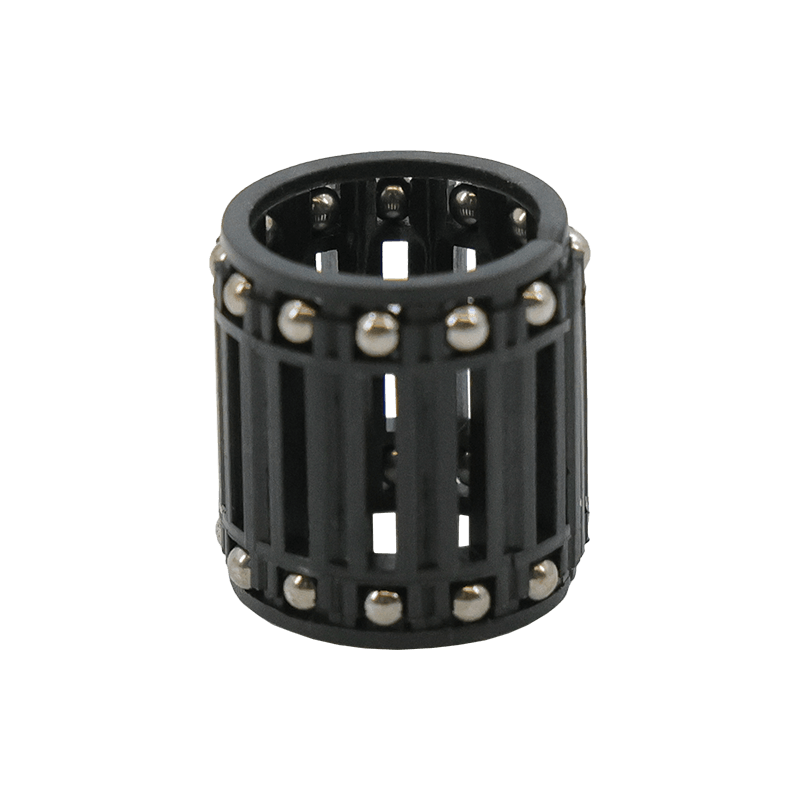
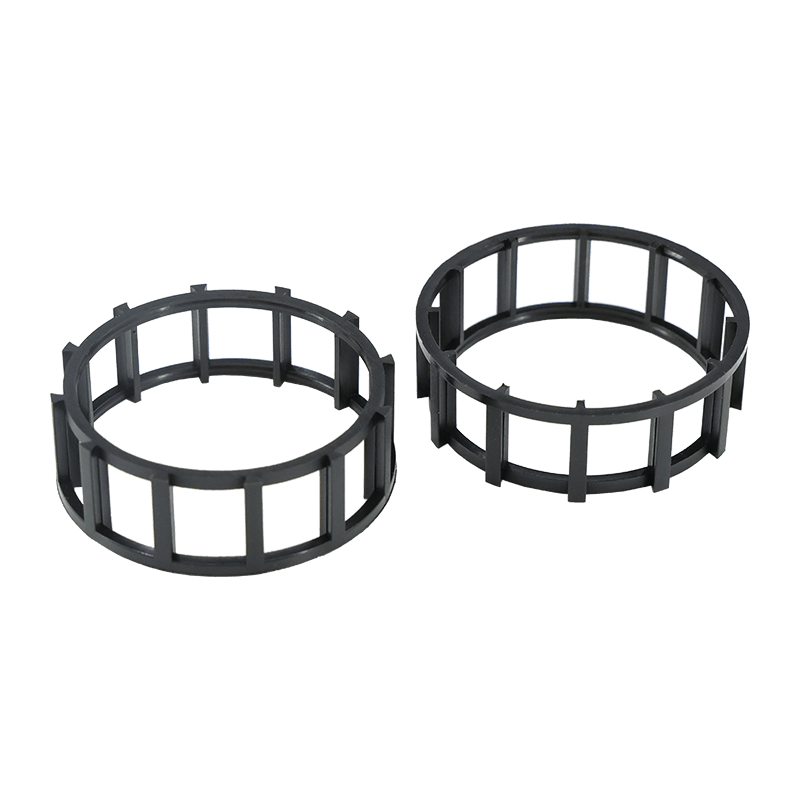
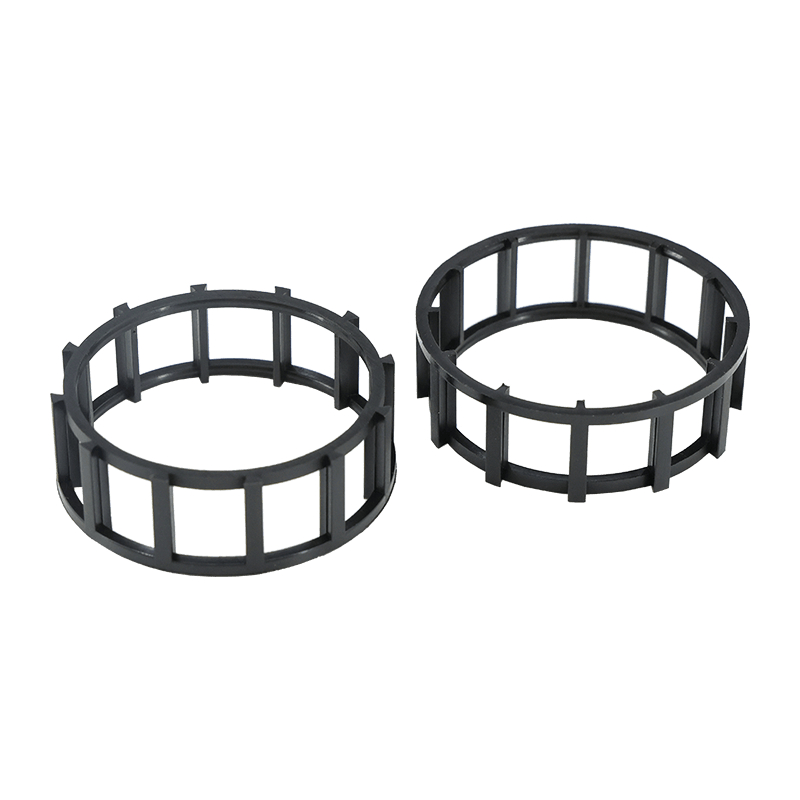 Black Plastic NJ Series Cylindrical Roller Bearing CageInjection-molded NJ-series cage for cylindrical roller bearings; avoids rivets and staking while maintaining precise roller spacing and axial positioning.View Product →
That trade-off is not free. Molded cages have temperature and load limits, and the tooling investment only makes sense once volumes and geometry are stable. But in cylindrical roller applications where a riveted two-piece cage was the historical default, a molded alternative is often worth evaluating before the first staking press is purchased.
Retention in Needle Roller and Cage Assemblies
Needle roller and cage assemblies follow a different logic. The cage holds the needles at the correct spacing, while radial location comes from the shaft and housing bore rather than from a staked joint. That makes cage pocket geometry, radial clearance, and material stiffness the critical variables, and it means staking is usually reserved for the surrounding housing rather than the cage itself.
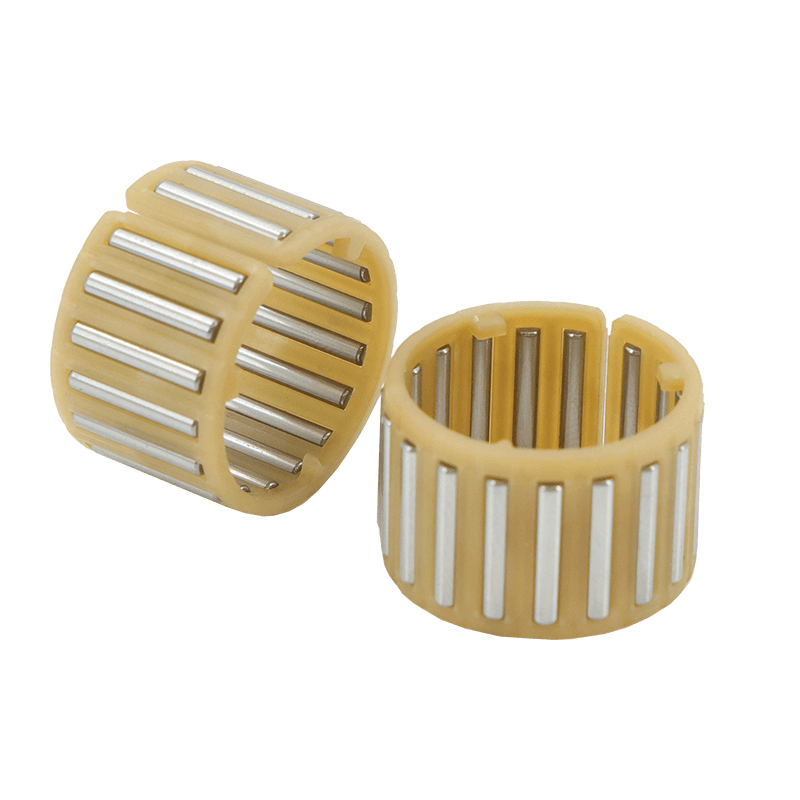
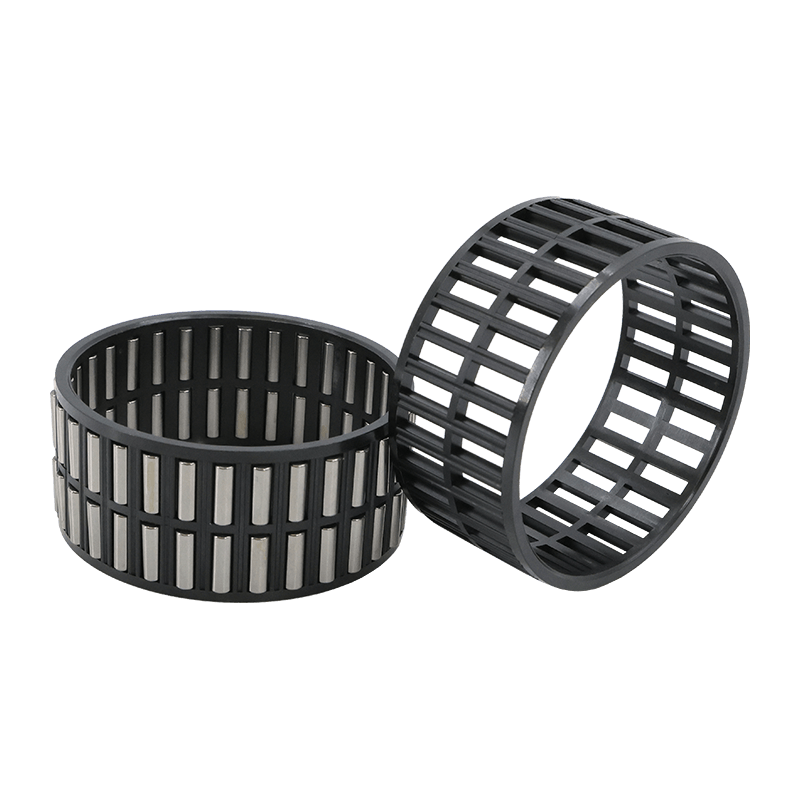 K/KK Series Radial Needle Roller and Cage AssemblySpace-efficient K/KK needle roller and cage unit with precision-ground rollers; polymer or steel cage supports high radial loads in compact housings.View Product →
When a customer moves from a two-piece riveted design to a molded assembly, the first questions we ask are about shaft hardness, lubrication, and operating temperature, because those three factors decide whether the change is straightforward or needs a redesign.
Staking in Automotive and Industrial Assemblies
Automotive components are where staking is most visible, simply because the volumes are high and the assemblies are small. Gear shift mechanisms, seat actuators, window lift motors, and small pumps all use staked retention in some form. In these applications, the assembly is only as good as the cage inside it: even a small amount of cage distortion shows up as shift effort, rattling, or uneven motor current.
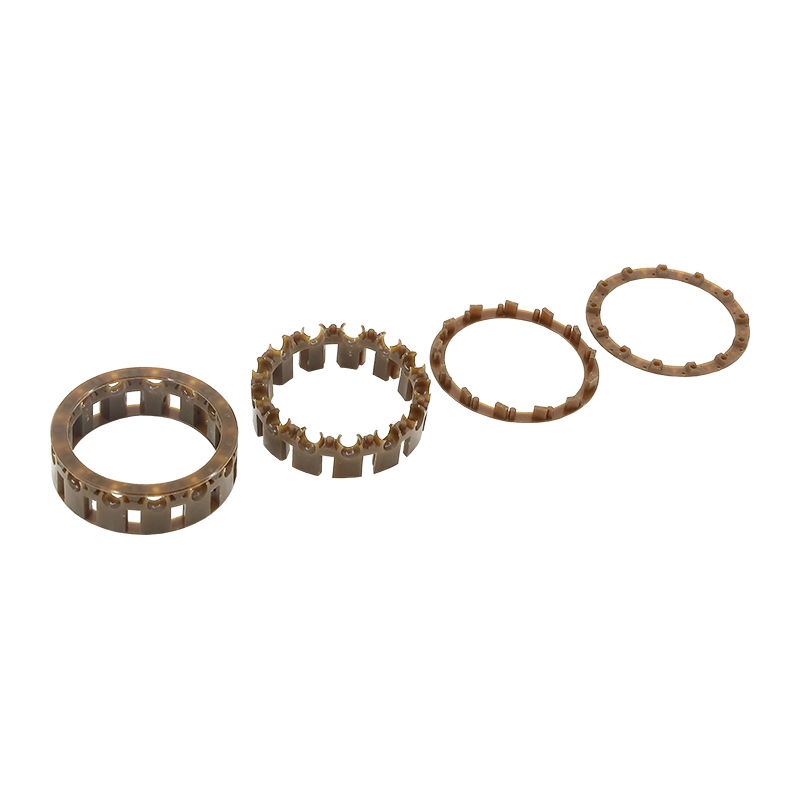
 6V40 Automotive Gear Shift Bearing CagePrecision 6V40 cage for gear shift bearings, engineered to maintain rolling element spacing through repeated oscillation and preserve shift feel.View Product →
Our own focus is on the plastic side of that equation. Since 2014 we have run an in-house tooling and development team, which means a cage geometry can be adjusted and re-sampled without waiting on an outside mold shop. Working that way is slower than quoting from a catalogue, but it is how most of our long-term automotive projects actually started.
Choosing the Right Approach With Your Cage Partner
Staking is not the enemy. It is a fast, reliable, well-understood process that suits thousands of assemblies. The problem is when staking is used to compensate for a cage design that would be better molded as one piece, or when it is specified without thinking through where the force goes.
If you would like to see how our team and factory are set up, or read a practical guide on evaluating a plastic cage supplier beyond price, both are available on the site. We are always happy to look at a drawing, discuss whether a molded cage can replace a staked joint, and tell you honestly when staking is still the better answer.