

 English
 中文简体
 عربى

YITENG
YITENG
YITENG
YITENG
YITENG
YITENG
YITENG
YITENG
YITENG
Content
Ask a maintenance engineer what keeps a self-aligning bearing out of trouble, and the answer is usually raceways and lubrication. Ask a cage maker, and the answer sounds a little different. The spherical cage is the part that holds every roller or ball in its own pocket, at a controlled distance, while the bearing follows a shaft that flexes and a housing that is never perfectly aligned. Get that small component right and the whole bearing behaves predictably; get it wrong and noise, heat and wear appear almost immediately.
We have been molding bearing cages and engineering plastic parts since 2009, first as Jiashan Weida Plastics Factory and today as Jiaxing Yiteng Intelligent Technology Co., Ltd. That background is described on our about page, and it explains why spherical cages take up so much of our working day. What follows is what we have learned about the design, material and production decisions behind a dependable spherical cage.
What Exactly Is a Spherical Cage?
Spherical cage is a practical shop-floor term rather than a formal standard designation. It normally describes a retainer whose guiding surfaces follow a spherical or barrel-shaped path, so the rolling elements can articulate as the bearing self-aligns. Three situations come up most often:
- Barrel roller cages for spherical roller bearings, where pockets must accommodate rollers that tilt as the inner and outer rings move out of parallel.
- Ball cages for self-aligning ball bearings, where two rows of balls share a common spherical raceway in the outer ring.
- Cages with a spherical seat, such as thrust designs in which the housing washer is spherically seated to absorb misalignment.
In every case the cage performs the same essential duties: separate the rolling elements, keep them evenly spaced, guide them through loaded and unloaded zones, and hold lubricant close to the contact surfaces without adding unnecessary friction or mass.
Naturally, not every roller application needs a spherical profile. Many customers pair spherical cages with more conventional retainers in the same machine, and a useful reference point for that wider family is our cylindrical roller cage range.
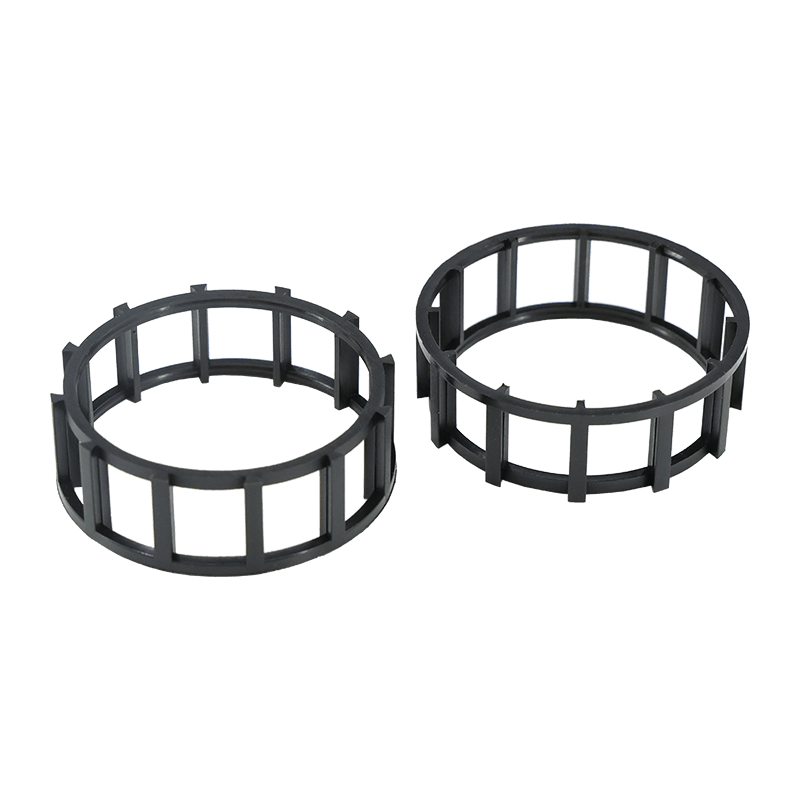
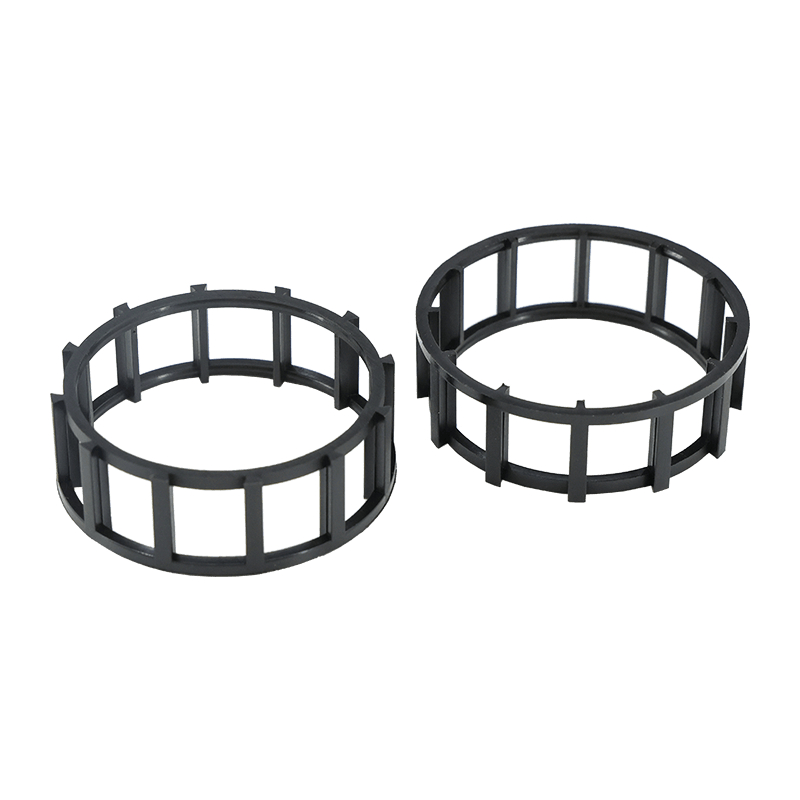 Black Plastic Cylindrical Roller Bearing CageThe NJ series standard cylindrical roller bearing cage is a key precision component for achieving this performance—it maintains precise roller spacing, guides each rol...View Product →
Why the Cage Shape Decides Bearing Behaviour
Misalignment is the whole point
Self-aligning bearings exist because shafts deflect and housings are rarely perfect. When the inner ring tilts relative to the outer ring, each rolling element has to change its angle inside the bearing. A spherical cage permits that movement through controlled articulation instead of forcing the roller to fight the pocket wall. If clearance is too tight, the cage scuffs and generates heat. If it is too loose, the rollers skew, and the result shows up as vibration and uneven wear.
Pocket clearance and roller guidance
Pocket clearance is one of the most sensitive dimensions in a molded cage. We normally hold pocket width and length in a band that keeps the roller square to the raceway while leaving room for thermal growth. On nylon cages we also watch the pillar thickness between pockets, because that is where cracks begin when a wall is too thin or a weld line lands in the wrong place.
Lubrication, mass and quiet running
A cage also acts as a small lubricant reservoir, carrying grease or oil into the contact zone on every revolution. Polymer cages are lighter than brass or steel, so centrifugal loading and start-up friction are lower. In noise-sensitive equipment such as textile machinery, the combination of nylon's natural damping and uniform pockets is often the reason a polymer retainer is chosen over metal.
Materials Used for Spherical Cages
Material choice usually follows temperature, speed and load rather than personal preference. The table below summarises how the common retainer materials compare in everyday practice.
| Material | Typical continuous temperature | Common use in spherical cages | Practical notes |
|---|---|---|---|
| Unfilled PA66 nylon | Around -40 to +100 C | Light and medium duty ball cages, textile machinery | Low friction, quiet running, good elasticity |
| Glass-filled PA66 / PA46 | Around -40 to +120 C | Spherical roller cages, industrial and automotive duty | Higher stiffness and better creep resistance |
| POM | Up to roughly +90 C | Precision ball cages with tight pockets | Excellent dimensional stability |
| Machined brass | Up to around +250 C | Heavy-duty and high-speed spherical roller bearings | Strong and repairable, but heavier and costlier |
| Pressed steel | Up to around +200 C | High-temperature spherical roller bearings | Economical in volume, pocket finish matters |
| PEEK | Above +250 C | Extreme temperature or chemical exposure | Premium cost, usually specified late in a project |
In practice, most of our spherical cage work sits in the nylon columns, because that is where the cost, weight and noise advantages are strongest. Metal cages still win on very high temperatures and on the heaviest duty cycles.
Design and Tooling Details That Matter
A spherical cage looks simple on a drawing, but a handful of details decide whether it survives a million revolutions or a thousand. These are the points we review before a mold is cut:
- Pocket geometry matched to the roller or ball profile, including crown radius and corner radii.
- Pillar and rim thickness strong enough for the load path, light enough to keep inertia low.
- Split-line and snap-fit design for cages that must be assembled around a shaft or a full roller complement.
- Draft angles and chamfers that let the part release cleanly without scuffing the guiding surfaces.
- Gate location chosen so weld lines do not finish in high-stress pillars.
- Shrinkage compensation built into the tool, because nylon moves as it cools and again as it absorbs moisture.
- Marking and batch identification, so any production lot can be traced back to its mold and material batch.
Some projects become simpler when the cage arrives already matched to its roller set, rather than being assembled on the customer's line. That option is worth discussing early, and it is the idea behind our pre-assembled bearing cage units.
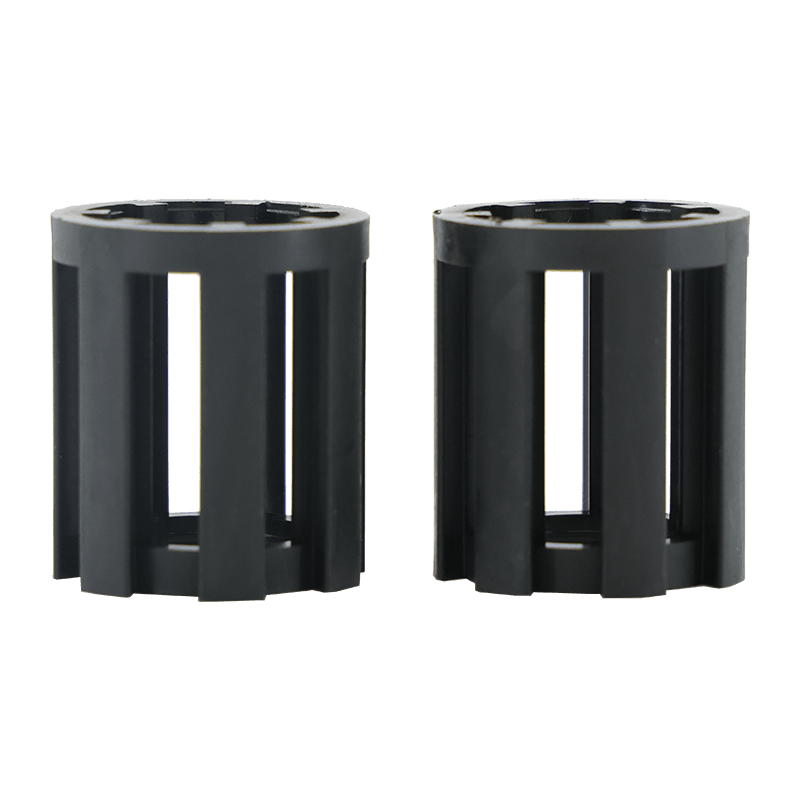
 Nylon Cylindrical Roller Bearing Cage Assembly UnitThe Bearing Cage Assembly Unit takes this philosophy to its logical conclusion: a fully assembled, ready-to-install cylindrical roller cage unit that combines the cage...View Product →
How We Mold and Inspect Spherical Cages
Our technical team has handled mold development and new product design since 2014, and the company has worked to a quality management system certified to ISO 9001 since 2013. That means tool design, material selection and process settings are documented rather than improvised. Injection parameters are recorded for each mold, and capacity was expanded in 2018 to keep lead times workable as order volumes grew.
Inspection focuses on the features that actually influence bearing behaviour: pocket width and length, cage outside and inside diameter, roundness and runout, wall thickness at the pillars, and a visual check for flash, short shots and weld-line marks on guiding surfaces. Dimensional results are recorded per batch, so if a question arises months later there is data to look at instead of a guess.
How to Select a Spherical Cage Supplier
Buying a spherical cage is rarely about the lowest quotation per thousand pieces. These are the points we would suggest checking with any supplier, including ourselves:
- Whether the material grade and temperature window genuinely match your application.
- Whether the supplier designs its own tooling, or depends on a third party for changes.
- Whether first-article inspection reports and dimensional data come with the samples.
- Whether batch-to-batch consistency is controlled, since pockets that vary ruin rollers.
- Whether the supplier can support trial fitting and follow-up on real running conditions.
- Whether communication is clear on lead times, packaging and change notification.
Price still matters, but it should be compared against total cost of ownership, including assembly time, scrap and field returns. This article on cage factory selection beyond price goes into that trade-off in more detail.
Where Spherical Cages Are Used
Because self-aligning bearings appear in so many machines, spherical cages end up in a wide range of equipment. Our own work clusters around several product families: automotive bearing cages for shift and gearbox components, needle roller cages for compact assemblies, textile machinery ball cages for spindles and rollers, industrial ball and linear cages for guides and conveying equipment, and cylindrical roller cages for general power transmission. Alongside those we mold engineering plastic parts and accessories that sit next to the bearing in the same assembly.
The common thread is misalignment, vibration or a need for quieter running. Wherever a machine has to tolerate a certain amount of deflection and still keep rolling elements evenly spaced, a well-made spherical cage earns its place.
If you are working on a self-aligning bearing project and the retainer is still an open question, we are glad to look at the drawing, the roller profile and the operating conditions with you. Samples, tooling discussions and factory visits are all part of how we work, and customers are welcome to contact us at +86 138 6736 9593 to talk through a spherical cage requirement in detail.