

 English
 中文简体
 عربى

YITENG
YITENG
YITENG
YITENG
YITENG
YITENG
YITENG
YITENG
YITENG
Content
- 1 What Exactly Is a Dry Film Lubricant?
- 2 Common Types of Dry Film Lubricants and Their Properties
- 3 Why Combine Dry Film Lubricants with Plastic Bearing Cages?
- 4 Application Methods for Dry Film Lubricants on Plastic Parts
- 5 Key Considerations When Selecting a Dry Film Lubricant for Plastic Cages
- 6 Real-World Applications Where Dry Film Lubricants Shine
- 7 Partnering for Optimal Performance
In precision-bearing applications, reducing friction without the mess and limitations of wet lubricants is a constant pursuit. Dry film lubricants offer a compelling solution, especially when combined with modern engineering plastics. At our factory, we have spent years perfecting nylon cages and other polymer components that work hand-in-hand with these solid lubricants to deliver quieter, more reliable operation. Let us guide you through the essentials of dry film lubricants and how they interact with the bearing cages and plastic parts we produce.
What Exactly Is a Dry Film Lubricant?
A dry film lubricant (DFL) is a solid material applied as a thin coating to reduce friction between two moving surfaces. Unlike conventional oils or greases, DFLs do not rely on a liquid film. Instead, they form a durable, low-friction layer that adheres to the substrate. Typical solid lubricants include graphite, molybdenum disulfide (MoS₂), and polytetrafluoroethylene (PTFE). These materials are either sprayed, dipped, or brushed onto the surface and then cured, leaving a dry coating that withstands extreme temperatures, vacuum environments, and contamination.
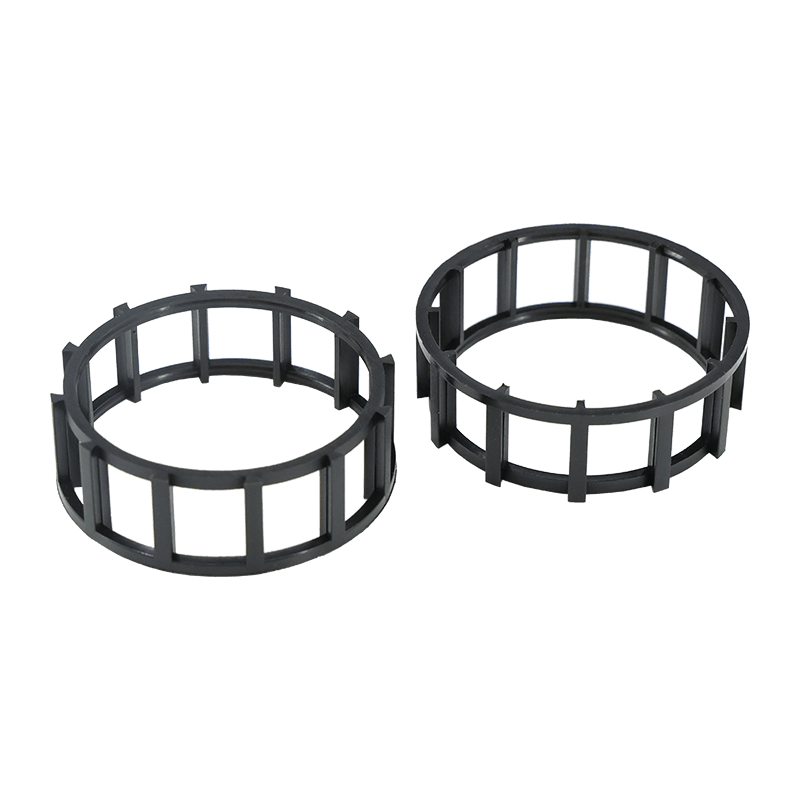
For bearing cages made from nylon or other engineering plastics, dry film lubricants can be especially valuable. The coating prevents metal-to-polymer or polymer-to-polymer galling, reduces wear, and maintains smooth motion even when traditional lubricants would degrade. In our experience, selecting the right DFL for a plastic cage requires understanding both the lubricant’s chemical compatibility and the cage’s operating conditions.
Common Types of Dry Film Lubricants and Their Properties
Each solid lubricant brings unique characteristics. The table below summarizes the most widely used DFLs in bearing and mechanical applications.
| Lubricant | Max Temperature | Coefficient of Friction | Chemical Resistance |
|---|---|---|---|
| Graphite | ~500°C (inert atmosphere) | 0.1–0.2 | Good in dry environments |
| Molybdenum Disulfide (MoS₂) | ~350°C | 0.03–0.06 | Excellent in vacuum |
| PTFE | ~260°C | 0.04–0.08 | Excellent chemical inertness |
| Boron Nitride | ~900°C | 0.2–0.3 | Good in oxidizing environments |
When a nylon cage operates in a high-temperature or dusty environment, MoS₂ or PTFE-based DFLs are often the most reliable. We have tested these coatings on our nylon retainers and found that they significantly reduce start-up torque and extend service life, especially in applications where relubrication is difficult.
Why Combine Dry Film Lubricants with Plastic Bearing Cages?
Plastic cages—particularly those made from nylon 66 or reinforced polyamide—offer inherent advantages like light weight, corrosion resistance, and self-lubricating properties. However, under high loads or in the presence of debris, a supplementary solid lubricant can make a critical difference. The dry film fills microscopic surface irregularities on the cage and raceway, preventing metal-to-plastic adhesion and reducing wear.
In many of our customer applications, we have seen that applying a thin layer of dry film lubricant to a nylon cage allows the bearing to run smoother and quieter from the very first rotation. This is especially important in automotive shift mechanisms, textile machinery, and linear motion systems—fields we serve extensively. For example, our  Plastic Self-lubricating Composite Sleeve with Embedded LubricantsThis sleeve integrates solid lubricants like PTFE or MoS₂ into its structure, continuously transferring a thin film to the contact interface. It eliminates the need for external dry film coatings on polymer components, offering maintenance-free operation in applications requiring precise temperature control.View Product → already incorporates advanced polymer technology to achieve low friction, but in extreme environments, a dry film coating can further enhance its performance.
Application Methods for Dry Film Lubricants on Plastic Parts
Applying DFLs to polymer components requires careful control of temperature and curing conditions, as plastics have lower heat tolerance than metals. Common methods include:
- Spraying – A fine mist of lubricant suspended in a solvent is applied evenly. Suitable for complex cage geometries.
- Dipping – The part is immersed in the lubricant solution, then drained and cured. Ideal for high-volume production.
- Brushing – Manual application for prototypes or repair work.
After application, the coating must be cured at a temperature that does not exceed the plastic’s heat deflection point. For nylon cages, we typically recommend curing at 80–120°C, depending on the lubricant formulation. Our manufacturing team has extensive experience with these processes, ensuring consistent coating thickness and adhesion.
Key Considerations When Selecting a Dry Film Lubricant for Plastic Cages
Not every DFL works well with every plastic. Here are the top factors to evaluate:
- Chemical compatibility – Some solvents in the lubricant can swell or weaken nylon. Always test on a sample.
- Operating temperature range – Ensure the DFL’s maximum temperature exceeds the bearing’s peak environment.
- Load capacity – High-contact pressures may require MoS₂ or graphite over PTFE.
- Environmental factors – Humidity, vacuum, or abrasive dust can degrade certain lubricants.
- FDA or food-grade requirements – If the application involves food contact, PTFE-based DFLs are often specified.
By partnering with a manufacturer that understands both plastic processing and dry film technology, you can avoid costly trial-and-error. Our engineering team routinely collaborates with clients to select the ideal cage material and lubricant combination for each use case.
Real-World Applications Where Dry Film Lubricants Shine
Dry film lubricants are indispensable in industries where wet lubricants cannot be used. Typical examples include:
- Automotive transmissions – Shift bearings with nylon cages coated in MoS₂ for smooth gear changes.
- Textile machinery – High-speed spindles where oil mist would contaminate fabric.
- Linear motion guides – Plastic cages with PTFE-based dry film for cleanroom environments.
- Aerospace actuators – Vacuum-compatible DFLs on polyimide cages.
In each of these sectors, the combination of a precisely molded engineering plastic cage and a carefully chosen dry film lubricant delivers reliability that wet lubricants alone cannot achieve. Our company has supplied cages for such demanding applications since 2009, and we continue to refine our processes based on field feedback.
Partnering for Optimal Performance
Choosing a dry film lubricant is only part of the equation. The cage’s geometry, material grade, and surface finish all influence how well the coating adheres and performs. As a manufacturer of nylon cages and engineering plastic parts, we bring decades of hands-on experience to this challenge. Whether you are developing a new bearing assembly or retrofitting an existing one, we invite you to explore our capabilities and learn more about what sets a reliable plastic cage supplier apart.
From material selection to coating integration, our team is ready to support your project. Let us help you make your bearing performance more precise, quiet, and reliable.